
Rising oil prices and ongoing geopolitical tensions have been the dominant forces behind stock market fluctuations in recent weeks. Brent crude oil hovering around $100 per barrel, prompting concerns that elevated energy costs could simultaneously dampen economic growth and push inflation higher.1 These developments compound existing worries, including the influence of artificial intelligence on established businesses, broad market valuations, private credit, and the future direction of Federal Reserve policy. Understandably, investors may find themselves questioning the resilience of their portfolios.
We have seen increased volatility in response to these headlines, and it can be tempting to make frequent adjustments to portfolios and financial plans. Legendary UCLA basketball coach John Wooden, once said “never mistake activity for achievement.” The same principle applies to investing. We believe the heavy lifting of sound financial planning should be done well before uncertainty arrives. A well-constructed portfolio is built around your goals and objectives, with a mix of asset classes designed to weather a variety of market conditions without constant tinkering. Late last year, anticipating a more volatile environment based on historical mid-term election year patterns along with levels in the market, we made thoughtful adjustments to our model portfolios. Those refinements were made deliberately and in advance, so that when volatility arrived, our models were well positioned.
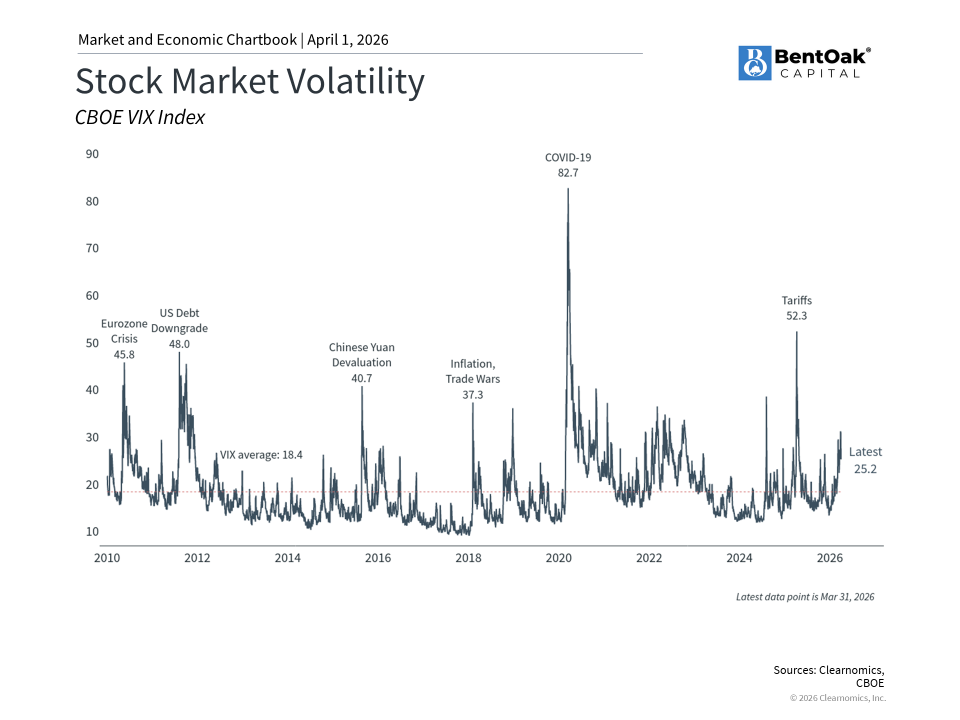
Even so, markets without a clear direction can be unsettling, especially when negative headlines dominate the news cycle. During periods like these, keeping a measured perspective is more important than ever. Long-term objectives should remain front and center, as disciplined saving and investing continue to be among the most effective ways to build wealth over time. With uncertainty persisting, what are the key things investors should keep in mind?
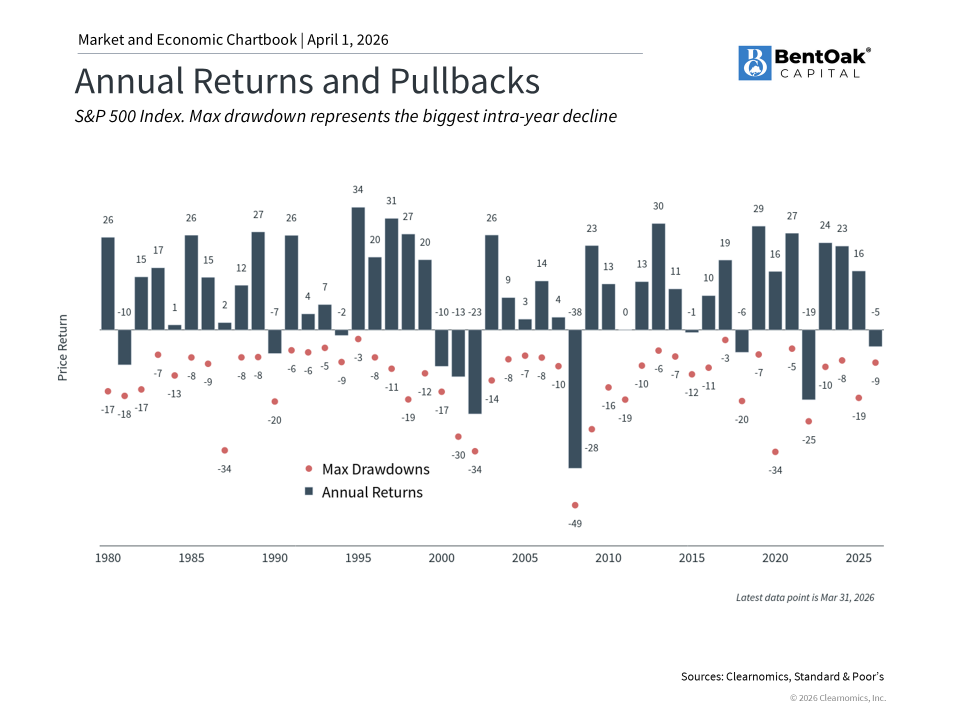
First, equity markets have been choppy to start 2025, with the S&P 500 pulling back from the all-time highs reached earlier in the year. While this can feel unsettling, drawdowns of this magnitude are a routine feature of functioning markets. In any given year, the average intra-year decline is -13.5%, yet most years end in positive territory, with markets averaging approximately 9% annual gains over time. Last year was a good example where the S&P 500 weathered six pullbacks driven largely by tariff and policy uncertainty, yet still delivered an almost 18% total return for the year.2 Investors who remain disciplined through short-term volatility have historically been better positioned to capture long-term returns.
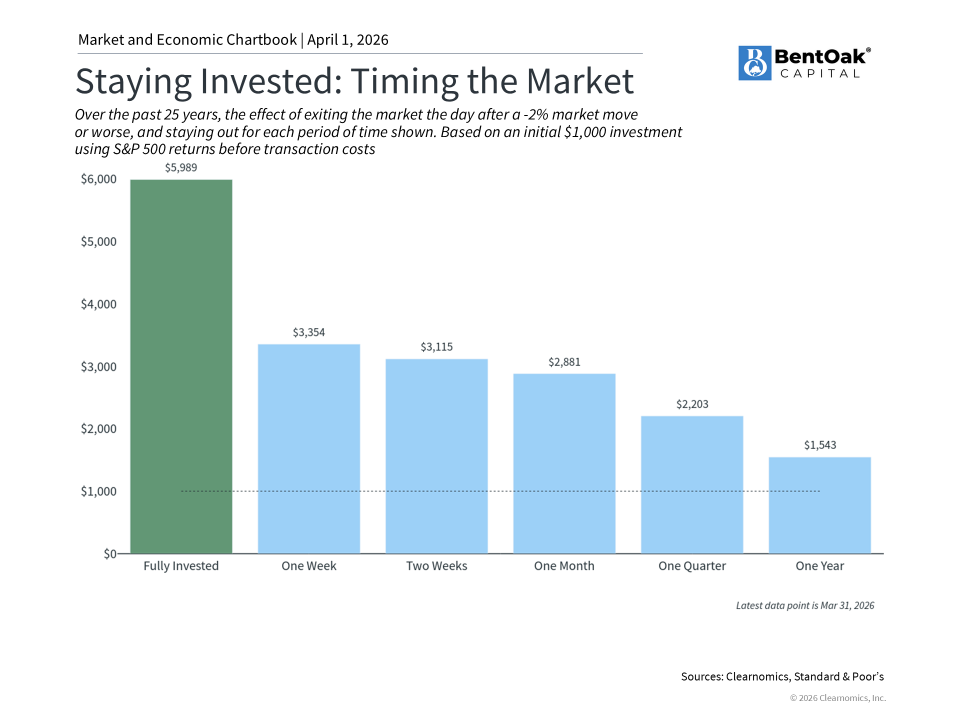
History has a clear message for investors, and it is simply that staying the course works. As the accompanying chart shows, missing even a single week following a volatile stretch has historically led to meaningfully worse outcomes. The market’s best days have a way of showing up right after its worst, and investors who moved to the sidelines often missed the very recoveries they were waiting for.
Second, while equities tend to grab the headlines, the bond market deserves equal attention. We have been talking with clients about fixed income quite a bit lately, particularly given that yields remain at attractive levels. Bonds serve as a core portfolio holding and often provide a helpful counterbalance during periods of stock market turbulence. That said, geopolitical developments have also touched fixed income markets, with the 10-year U.S. Treasury yield climbing back above 4% after briefly dipping to 3.9% when tensions in Iran first escalated. Inflation expectations remain a key driver of bond performance going forward, and we continue to monitor developments closely.
Some perspective is helpful here. Following the historic bond market selloff in 2022, when inflation and interest rates rose sharply, bonds staged a meaningful recovery and generated strong returns from 2023 through 2025. Since bottoming out in October 2022, the broad bond market [Bloomberg Aggregate Bond Index] has delivered approximately 20% in total returns through March 2026 (total return includes price change plus reinvested income), with certain sectors [Bloomberg High Yield Very Liquid Index] performing even better.
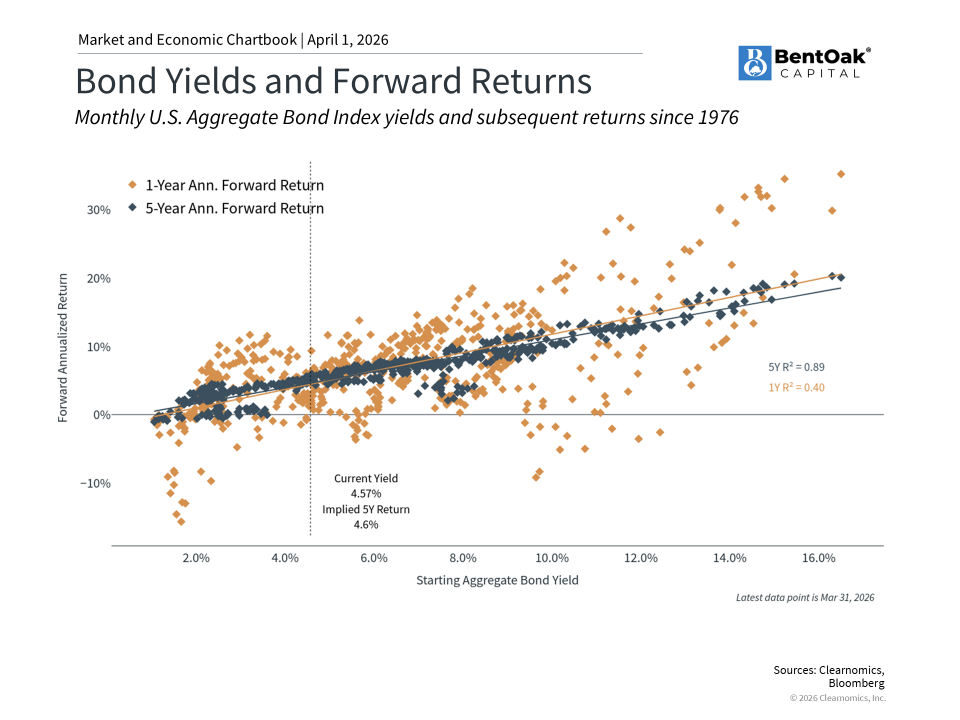
For long-term investors, the current yield environment remains compelling relative to the past almost 15 years. Today’s yields offer a level of income potential that simply was not available for much of that time. The yield on the U.S. Aggregate Bond Index currently stands at 4.5%, well above its average of 2.9% since 2009. As the accompanying chart illustrates, historically, periods that began with relatively elevated bond yields (here defined as yields above their long-term median, as shown in the chart) have often been followed by above‑average total returns over subsequent multi-year periods.
This is particularly relevant when compared to cash, where real yields, meaning yields after adjusting for inflation, remain negative. For those in or approaching retirement, the effective inflation rate may be even higher, given the rising cost of medical and insurance expenses. While cash can feel like a safe haven during uncertain times, a thoughtful allocation to bonds can help generate income, support long-term portfolio growth, and act as ballast during periods of equity volatility. Be aware that bonds do carry risks, including interest-rate sensitivity, credit risk, and inflation risk, that can affect both income and principal. A balanced approach, aligned with your broader goals, can help you navigate these tradeoffs with greater clarity and confidence.
Recent weeks have also reinforced the value of true diversification. Holding a well-balanced mix of investments across asset classes, sectors, and geographies can help smooth out performance during turbulent periods, making it easier to stay the course rather than making reactive decisions that could set back long-term financial plans.
However you follow the markets, whether through television, social media, or other channels, coverage tends to focus on a handful of familiar benchmarks: the S&P 500, the 10-year Treasury, or whichever sector happens to be making news. These are useful reference points, but they tell only part of the story. Diversification is a cornerstone of sound portfolio construction, and we believe in positioning portfolios strategically to reflect that principle. We live in a dynamic and evolving global economy, and when one area of a portfolio faces headwinds, another may provide balance. Over time, this approach, paired with a well-crafted financial plan, has helped investors participate in market growth while managing risk. That combination is ultimately what building toward long-term financial goals requires.
1https://www.cnbc.com/2026/04/01/oil-prices-today-brent-wti.html
IMPORTANT DISCLOSURE INFORMATION: Past performance may not be indicative of future results. Different types of investments involve varying degrees of risk. Therefore, it should not be assumed that future performance of any specific investment or investment strategy (including the investments and/or investment strategies recommended and/or undertaken by BentOak Capital [“BentOak”]), or any non-investment related services, will be profitable, equal any historical performance level(s), be suitable for your portfolio or individual situation, or prove successful. BentOak is neither a law firm, nor a certified public accounting firm, and no portion of its services should be construed as legal or accounting advice. Moreover, you should not assume that any discussion or information contained in this document serves as the receipt of, or as a substitute for personalized investment advice from BentOak. Please remember that it remains your responsibility to advise BentOak, in writing, if there are any changes in your personal/financial situation or investment objectives for the purpose of reviewing/evaluating/revising our previous recommendations and/or services, or if you would like to impose, add, or to modify any reasonable restrictions to our investment advisory services. A copy of our current written disclosure Brochure discussing our advisory services and fees is available upon request at www.bentoakcapital.com/disclosure. The scope of the services to be provided depends upon the needs of the client and the terms of the engagement. Historical performance results for investment indices, benchmarks, and/or categories have been provided for general informational/comparison purposes only, and generally do not reflect the deduction of transaction and/or custodial charges, the deduction of an investment management fee, nor the impact of taxes, the incurrence of which would have the effect of decreasing historical performance results. It should not be assumed that your account holdings correspond directly to any comparative indices or categories. Please Also Note: (1) performance results do not reflect the impact of taxes; (2) comparative benchmarks/indices may be more or less volatile than your accounts; and, (3) a description of each comparative benchmark/index is available upon request. Please Note: Limitations: Neither rankings and/or recognitions by unaffiliated rating services, publications, media, or other organizations, nor the achievement of any designation, certification, or license should be construed by a client or prospective client as a guarantee that he/she will experience a certain level of results if BentOak is engaged, or continues to be engaged, to provide investment advisory services. Rankings published by magazines, and others, generally base their selections exclusively on information prepared and/or submitted by the recognized adviser. Rankings are generally limited to participating advisers (see link as to participation criteria/methodology, to the extent applicable). Unless expressly indicated to the contrary, BentOak did not pay a fee to be included on any such ranking. No ranking or recognition should be construed as a current or past endorsement of BentOak by any of its clients. ANY QUESTIONS: BentOak’s Chief Compliance Officer remains available to address any questions regarding rankings and/or recognitions, including the criteria used for any reflected ranking.