
The last few weeks have been rough, and we know it. Between the elections, AI headlines, talking heads at the Federal Reserve debating and a market that has been active. We want to provide some context on what happened, how we’re thinking about it, and our strategy in these times.
Three points up front. The market fell into a correction the week of November 16th, 2026. Corrections are a normal part of investing. We remain a planning first firm, and your plan was built with volatile markets in mind.
What happened
The S&P 500 now sits about 10% below its record high of October 6. That qualifies as a correction, the term for a drop of 10% or more from a peak.
Several things contributed to the slide. Investors began questioning how much companies are spending on AI (both capital expenditures and debt issuance to fund), and headlines about several semiconductor companies (Nvidia and AMD) added to the unease. The Fed is weighing a rate increase in December. A surging dollar tightened financial conditions, and investors sold assets to raise cash. The midterm elections left open questions about policy and the AI buildout.
One detail offers some comfort, and it comes from credit markets. Investors who lend to riskier companies aren’t demanding much extra interest over what safe government bonds pay. Spreads on the weakest borrowers, those rated CCC, have widened some, but the stress looks concentrated and not widespread.
What history says
Corrections come around more often than most of us remember. Since 1928, the S&P 500 has fallen 10% from a record high 26 times.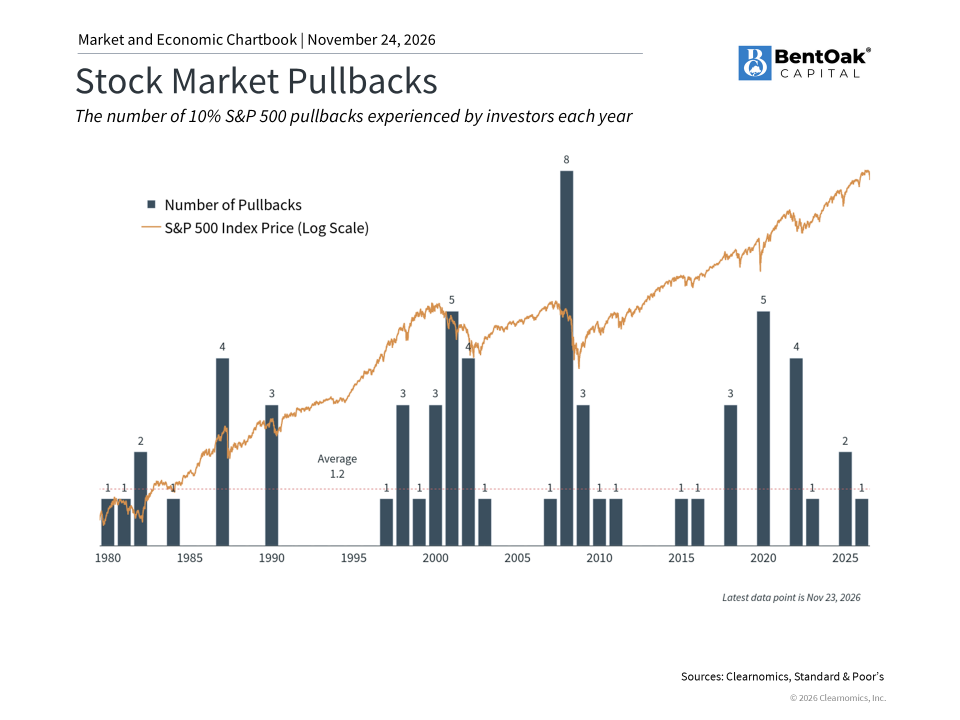
Spikes in fear have a record, too. After the 25 biggest weekly VIX spikes since 1990, average S&P 500 returns over the following three months to five years beat those of other periods. The three spikes bigger than this week’s (February 2020, August 2015 and April 2025) were each followed by gains over the next year. Not every case worked out, though.
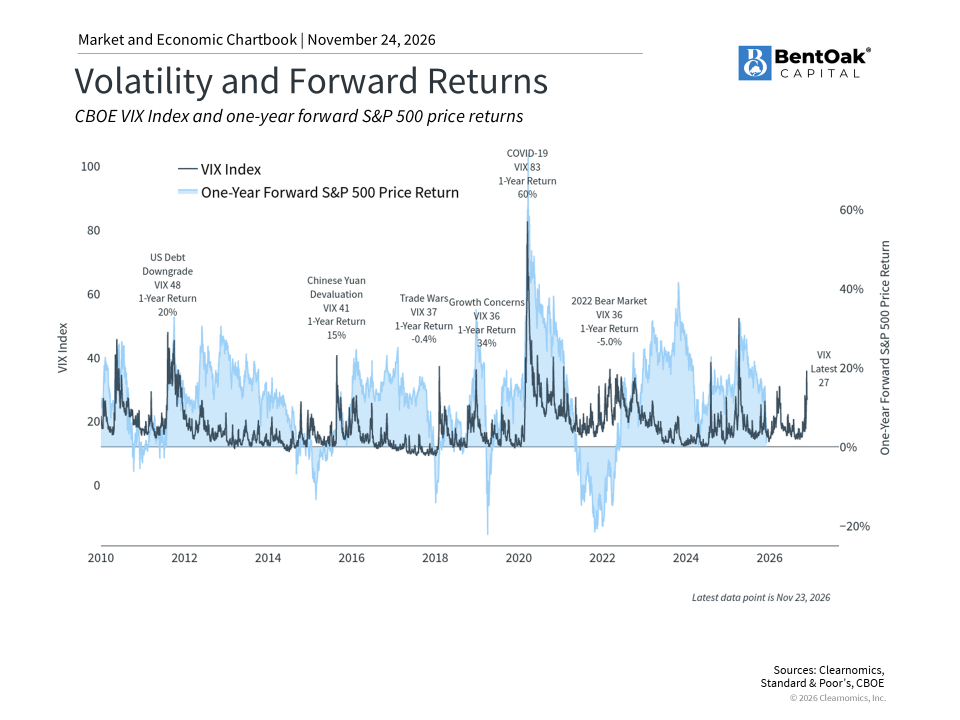
2018 offers a useful comparison: another midterm year, another stretch of Fed rate hikes. Stocks fell nearly 20% into late December, then recovered most of that loss by the first quarter of 2019. The low arrived after the headlines had peaked, which is why we wouldn’t rule out more volatility between now and year-end.
Underneath all of this sits a simple principle. Market bottoms are difficult to predict reliably, and selling near the lows can lock in losses and leave investors on the sidelines if markets recover.
What hasn’t changed
Your plan is designed for periods like these, and we also manage portfolios knowing this might happen. We maintain funds for known short term needs in cash or cash equivalents. That way your spending doesn’t depend on selling stocks while prices are down, and your stock holdings have time to recover.
Company profits are holding up. S&P 500 earnings for the third quarter are running about 32% above a year ago, and the majority of companies beating expectations(1). Prices have fallen. Earnings have not.
Inflation pressure is easing, too. JPMorgan Asset Management’s David Kelly expects falling gasoline prices alone to trim November’s year-over-year inflation increase by 0.4 percentage points.
Other “buyers” in the market have not gone anywhere. 401(k) contributions occur on a regular and recurring basis. With earnings announcements also comes company share buybacks still at some very large figures(2).
Why diversification matters
This selloff hit unevenly. Technology and AI-linked leaders drove the decline, and the high-flying stocks that led the market higher have led it lower. Portfolios built around a few big winners felt it most. Keep in mind that the S&P 500 is market cap weighted, so the larger the company, the heavier the weighting. For perspective, just 4 names that have seen (Nvidia, Broadcom, AMD, and Micron) make up almost 9.3% of the S&P 500.
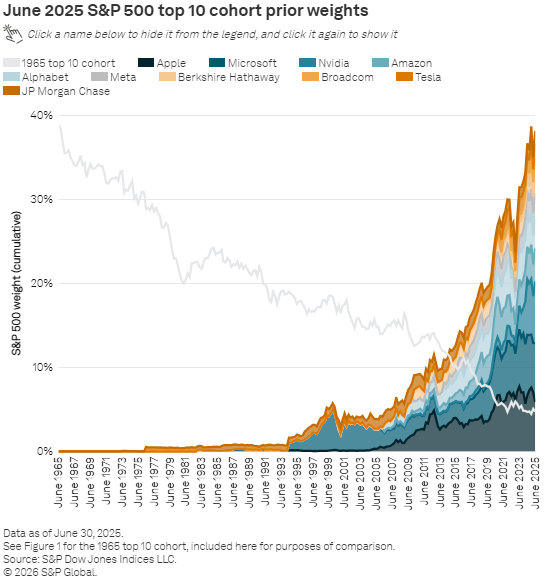
Disciplined diversification across asset classes, sectors, investing styles and time horizons smooths the ride, but it can’t prevent losses. In a selloff like this one, even some of the holdings meant to cushion a portfolio are impacted.
Our approach at BentOak Capital hasn’t changed. We plan to stay with your plan and portfolio mix, rebalance when necessary rather than reacting to headlines, and keep an eye on position sizes so they stay where they should be.
What we’re watching
December brings two dates that matter: the Fed’s rate decision and the federal funding deadline. December 2018 included both a rate hike and a partial government shutdown, so we’re not treating these as routine.
On the Fed, one governor has argued for a 50 basis point increase, which seems extreme. In viewing the Fed futures data, many are expecting a single 25 basis point increase in December, then a pause, since rates already sit near neutral. We’re also watching whether credit stress moves beyond the weakest borrowers, and how the dollar and market liquidity behave.
Where this leaves us
Corrections like this one are uncomfortable, and they’re also part of how long-term investing works. Earnings are strong, broad credit markets are relatively calm, and past fear spikes have, on average, been followed by better-than-normal returns. The fourth quarter of 2018 has some interesting resemblance, and the market recovered most of its losses within a few months. That won’t happen on a schedule, but it shows why we stick with a plan instead of reacting to the news. We manage in decades, not weeks, and your plan was built that way. A hard November doesn’t change that.
If something in your life has changed, or you’d like to talk through year-end planning, let’s talk. Also, not everyone wants to talk about the market when it’s bumpy, and that’s okay. If you do, we’re ready, so give us a call or set up a review.
As Thanksgiving arrives, we hope you’re surrounded by family and friends. There is much to be grateful for, and we’re grateful for you. Wishing you a blessed holiday.
1. https://www.investing.com/analysis/sp-500-earnings-grow-329-but-smaller-surprises-raise-questions-for-q4-200692143
2. https://www.nb.com/insights/market-signals-equity-buybacks-shifting-buyer-base-drives-record-high-activity?cid=____
IMPORTANT DISCLOSURE INFORMATION: Past performance may not be indicative of future results. Different types of investments involve varying degrees of risk. Therefore, it should not be assumed that future performance of any specific investment or investment strategy (including the investments and/or investment strategies recommended and/or undertaken by BentOak Capital [“BentOak”]), or any non-investment related services, will be profitable, equal any historical performance level(s), be suitable for your portfolio or individual situation, or prove successful. BentOak is neither a law firm, nor a certified public accounting firm, and no portion of its services should be construed as legal or accounting advice. Moreover, you should not assume that any discussion or information contained in this document serves as the receipt of, or as a substitute for personalized investment advice from BentOak. Please remember that it remains your responsibility to advise BentOak, in writing, if there are any changes in your personal/financial situation or investment objectives for the purpose of reviewing/evaluating/revising our previous recommendations and/or services, or if you would like to impose, add, or to modify any reasonable restrictions to our investment advisory services. A copy of our current written disclosure Brochure discussing our advisory services and fees is available upon request at www.bentoakcapital.com/disclosure. The scope of the services to be provided depends upon the needs of the client and the terms of the engagement. Historical performance results for investment indices, benchmarks, and/or categories have been provided for general informational/comparison purposes only, and generally do not reflect the deduction of transaction and/or custodial charges, the deduction of an investment management fee, nor the impact of taxes, the incurrence of which would have the effect of decreasing historical performance results. It should not be assumed that your account holdings correspond directly to any comparative indices or categories. Please Also Note: (1) performance results do not reflect the impact of taxes; (2) comparative benchmarks/indices may be more or less volatile than your accounts; and, (3) a description of each comparative benchmark/index is available upon request. Please Note: Limitations: Neither rankings and/or recognitions by unaffiliated rating services, publications, media, or other organizations, nor the achievement of any designation, certification, or license should be construed by a client or prospective client as a guarantee that he/she will experience a certain level of results if BentOak is engaged, or continues to be engaged, to provide investment advisory services. Rankings published by magazines, and others, generally base their selections exclusively on information prepared and/or submitted by the recognized adviser. Rankings are generally limited to participating advisers (see link as to participation criteria/methodology, to the extent applicable). Unless expressly indicated to the contrary, BentOak did not pay a fee to be included on any such ranking. No ranking or recognition should be construed as a current or past endorsement of BentOak by any of its clients. ANY QUESTIONS: BentOak’s Chief Compliance Officer remains available to address any questions regarding rankings and/or recognitions, including the criteria used for any reflected ranking.