
The Nobel Prize-winning economist Paul Romer once wrote that “economic growth springs from better recipes, not just from more cooking.”1 This foundational economic insight holds that raising living standards depends not only on deploying more workers or more equipment, but on enabling each worker to produce greater quantities and higher quality goods and services.
This idea is captured by the concept of “productivity,” which represents the primary driver of the kind of economic growth that improves wages and quality of life. It is also one of the most pressing questions in today’s economy, as the adoption of artificial intelligence continues to accelerate.
AI and Federal Reserve policy may appear unrelated at first glance, but the two are closely connected. In the short run, this connection runs through their combined effects on financial markets and interest rates. Over the longer run, the link is through productivity and economic growth. Fed Chair Kevin Warsh recently addressed both subjects at the Fed’s annual symposium in Jackson Hole, Wyoming.2 Given the significant impact AI has already had on markets in recent years, and the ongoing uncertainty surrounding the Fed’s policy direction, what should investors consider from a long-term perspective?
AI’s role in shaping long-run economic growth
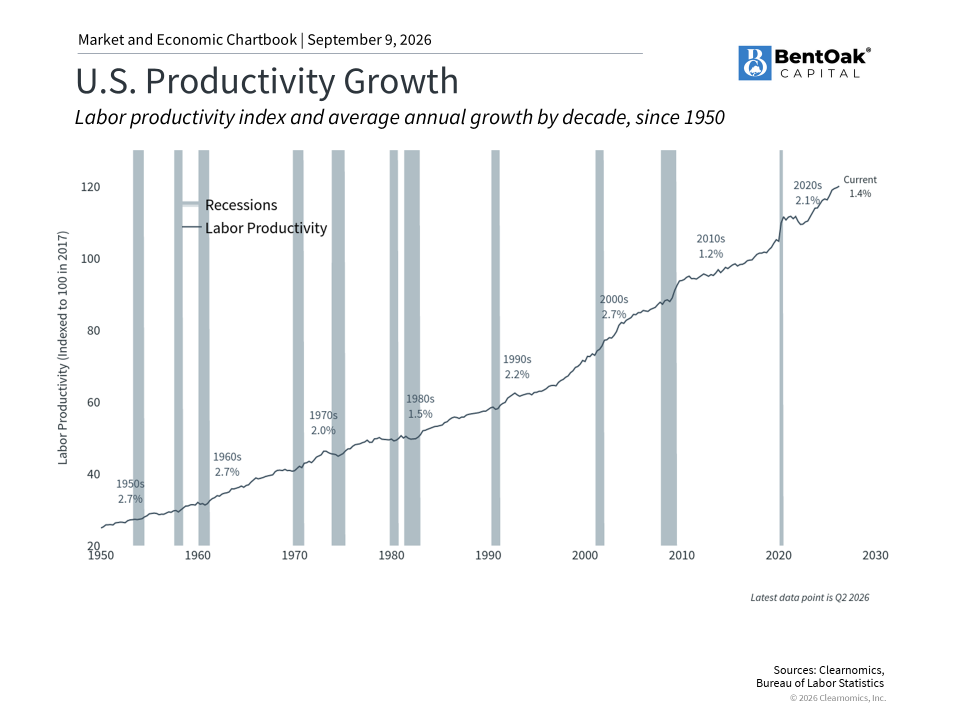
Understanding why productivity matters requires a brief look at how economists think about growth. Standard economic models center on workers and “capital,” a term that encompasses equipment, machines, and tools. Equally important, however, are education and technology, both of which allow workers to produce more output using the same amount of capital.
Consider a restaurant. It can produce more meals by adding cooks, upgrading equipment, or better training its staff to make the most of available tools and ingredients. Similarly, a more knowledgeable doctor with access to advanced facilities can achieve better patient outcomes. While economic models inevitably simplify the real world, the core insight is that generating more and better output per worker, across any field, is what genuinely drives improvements in wages and living standards over time.
This is why productivity growth carries such significance, even though it is difficult to measure precisely. What makes AI’s potential impact both fascinating and hard to forecast is that it touches nearly all of these factors simultaneously. Depending on one’s perspective, AI can be viewed as a form of labor, a type of capital, and a catalyst for creating entirely new methods and technologies. Warsh, for instance, framed this question in his speech as whether AI would be “complementary or competitive to labor.”
The science fiction version of the answer envisions AI replacing workers entirely, particularly in roles centered on information, such as data analytics or computer programming. Yet current evidence does not clearly support this outcome. The data so far suggests that AI may instead function as another tool that helps workers accomplish more, much as the information technology revolution did in prior decades. As early evidence of this shift, some companies are now rehiring after previously reducing their workforces due to AI.3
The chart above illustrates that productivity growth has varied considerably across decades, but has typically risen alongside the adoption of new technologies. The expansion of the 1990s, for instance, was accompanied by an acceleration in output per worker, even though it took time to materialize.4
Inflation continues to be the Fed’s primary concern
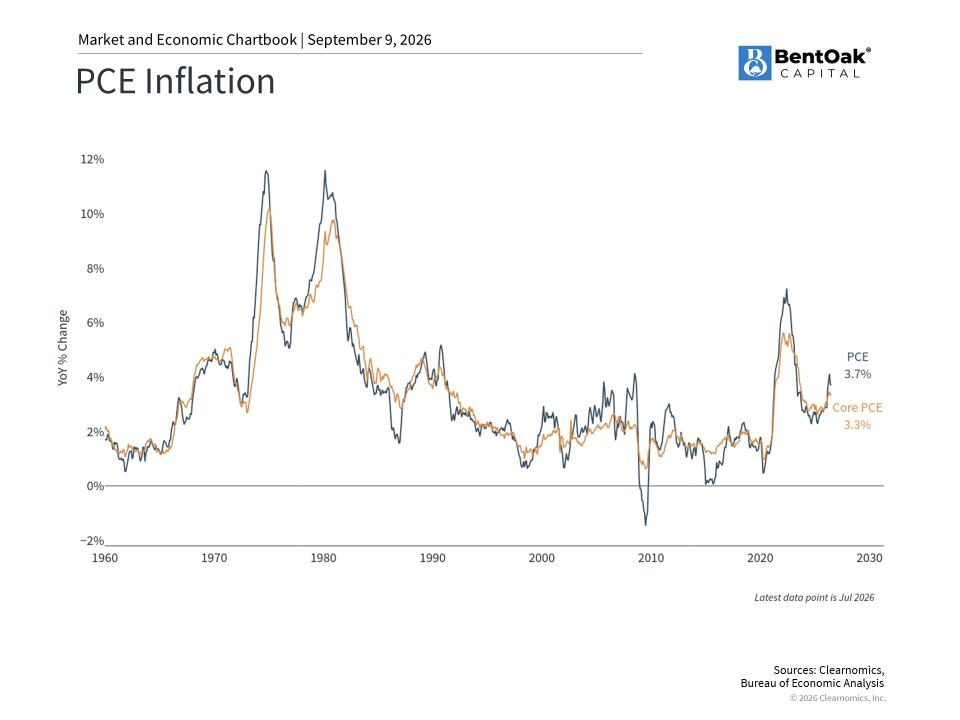
The Fed’s more immediate concern remains inflation. The Fed’s preferred measure, the Personal Consumption Expenditures price index, shows that inflation rose 3.7% year-over-year, with core PCE at 3.3%.5 Both measures remain well above the Fed’s 2% target, and progress over the past two years has been limited, in part due to higher oil and gasoline prices stemming from the conflict in the Middle East. In the near term, this places the Fed in a challenging position as it works to balance growth with persistent price pressures.
Markets have been attempting to anticipate when the Fed might raise rates, contributing to recent bouts of volatility. Current expectations point to at least one rate hike by the end of this year. These expectations can shift quickly as new data and Fed guidance emerge, and they have already moved substantially over the past several months.
Over the longer run, however, the picture could look quite different, depending on how AI and other technology (e.g. robotics) trends unfold. Technology tends to be naturally deflationary, since more output and higher quality goods can put downward pressure on prices over time. If AI were to meaningfully lift productivity, the economy could then support faster growth and higher wages alongside more moderate inflation.
This dynamic is especially relevant given that many current sources of inflation trace back to more recent factors, such as oil prices, data center construction, semiconductor shortages, and similar pressures. These drivers have less to do with monetary policy or productivity, and could diminish over time. That process takes time, however, and surprises are possible along the way, making it important for investors to avoid placing too much weight on any single inflation report.
The labor market remains an important variable to watch
In the near term, current labor market conditions suggest the economy remains on solid footing. While layoffs have touched certain sectors, many of these trends reflect broader cost-cutting efforts and technology adoption, not AI adoption specifically. Most notably, the unemployment rate stands at a historically low 4.1% and has been stable for the past two years. Wage growth has slowed, but at 3.1% on a year-over-year basis, earnings remain strong by historical standards.6
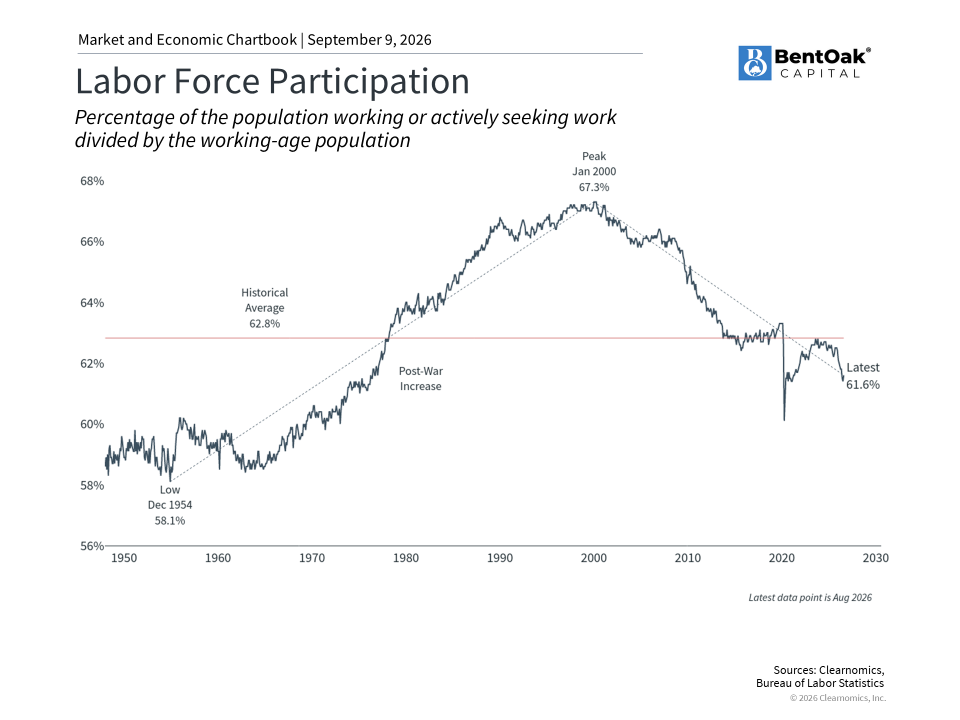
Why has unemployment remained so low even as monthly job gains have been uneven? One key reason is that the supply of labor has grown very slowly, reflecting aging demographics and reduced immigration. The labor force participation rate fell to 61% in July, near its lowest level in decades, as more people exit the workforce, including many baby boomers.
Current policy has further slowed the expansion of the available labor pool. When labor supply is barely growing, monthly job gains can naturally be modest, even as workers hold onto existing positions and companies continue to hire when the need arises. This may help explain why initial jobless claims, which reflect workers seeking benefits following layoffs, remain near historic lows.
Across technology, inflation, and the labor market, investors are well served by balancing short-term factors against longer-term trends. In the near term, markets face continued uncertainty tied to the conflict in the Middle East, the pace of data center buildouts, and other variables. Over years and decades, productivity growth and broader economic fundamentals are what will shape financial markets. Maintaining focus on long-term goals that are identified and accounted for in the financial plan and portfolio remains one of the most reliable paths toward financial success.
References
- https://paulromer.net/economic-growth/
- https://www.federalreserve.gov/newsevents/speech/warsh20260828a.htm
- https://www.cnbc.com/2026/07/01/employers-who-laid-off-workers-for-ai-are-reversing-theirdecisions.
htm - https://www.bls.gov/news.release/prod2.nr0.htm
- https://www.bea.gov/data/personal-consumption-expenditures-price-index
- https://www.bls.gov/news.release/empsit.nr0.htm
IMPORTANT DISCLOSURE INFORMATION: Past performance may not be indicative of future results. Different types of investments involve varying degrees of risk. Therefore, it should not be assumed that future performance of any specific investment or investment strategy (including the investments and/or investment strategies recommended and/or undertaken by BentOak Capital [“BentOak”]), or any non-investment related services, will be profitable, equal any historical performance level(s), be suitable for your portfolio or individual situation, or prove successful. BentOak is neither a law firm, nor a certified public accounting firm, and no portion of its services should be construed as legal or accounting advice. Moreover, you should not assume that any discussion or information contained in this document serves as the receipt of, or as a substitute for personalized investment advice from BentOak. Please remember that it remains your responsibility to advise BentOak, in writing, if there are any changes in your personal/financial situation or investment objectives for the purpose of reviewing/evaluating/revising our previous recommendations and/or services, or if you would like to impose, add, or to modify any reasonable restrictions to our investment advisory services. A copy of our current written disclosure Brochure discussing our advisory services and fees is available upon request at www.bentoakcapital.com/disclosure. The scope of the services to be provided depends upon the needs of the client and the terms of the engagement. Historical performance results for investment indices, benchmarks, and/or categories have been provided for general informational/comparison purposes only, and generally do not reflect the deduction of transaction and/or custodial charges, the deduction of an investment management fee, nor the impact of taxes, the incurrence of which would have the effect of decreasing historical performance results. It should not be assumed that your account holdings correspond directly to any comparative indices or categories. Please Also Note: (1) performance results do not reflect the impact of taxes; (2) comparative benchmarks/indices may be more or less volatile than your accounts; and, (3) a description of each comparative benchmark/index is available upon request. Please Note: Limitations: Neither rankings and/or recognitions by unaffiliated rating services, publications, media, or other organizations, nor the achievement of any designation, certification, or license should be construed by a client or prospective client as a guarantee that he/she will experience a certain level of results if BentOak is engaged, or continues to be engaged, to provide investment advisory services. Rankings published by magazines, and others, generally base their selections exclusively on information prepared and/or submitted by the recognized adviser. Rankings are generally limited to participating advisers (see link as to participation criteria/methodology, to the extent applicable). Unless expressly indicated to the contrary, BentOak did not pay a fee to be included on any such ranking. No ranking or recognition should be construed as a current or past endorsement of BentOak by any of its clients. ANY QUESTIONS: BentOak’s Chief Compliance Officer remains available to address any questions regarding rankings and/or recognitions, including the criteria used for any reflected ranking.