
Markets have had no shortage of reasons to worry in recent years: pandemic aftershocks, supply chain disruptions, higher interest rates, regional banking stress, geopolitical conflict, energy volatility, and an ongoing debate over inflation.
And yet, the U.S. economy has continued to demonstrate resilience.
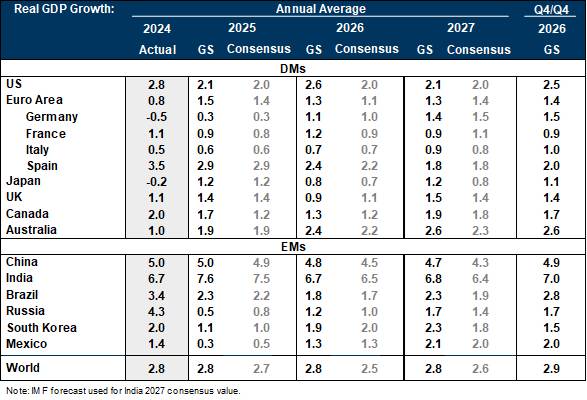
That does not mean recessions are impossible, markets cannot pull back, or risks should be ignored. It does mean investors should be careful about letting headlines drive long-term financial decisions. A sound financial plan is designed with uncertainty in mind, not around the assumption that the next six months will be calm.
Resilience Remains the Central Theme
One of the clearest themes from the first half of 2026 has been the continued adaptability of the U.S. economy. While growth has not been immune to pressure, the economy has benefited from several structural strengths:
- Deep and liquid capital markets
- A flexible labor market
- A strong entrepreneurial culture
- A broad base of innovative companies
- A history of adapting when economic conditions change
None of these advantages make the U.S. immune from downturns. But they do help explain why the economy has repeatedly absorbed shocks that felt severe in the moment.
For long-term investors, that perspective matters. Reacting to market volatility by making abrupt portfolio changes can create risks of its own, including the risk of missing recoveries or moving away from a plan built around long-term goals. The better question is not whether uncertainty exists, it always does, but whether your financial plan is built to withstand it.
Earnings Remain an Important Foundation
Corporate earnings remain one of the key underpinnings of the stock market. Valuations should always be monitored, particularly after periods of strong performance, but earnings and revenue trends continue to be important indicators of underlying business health.
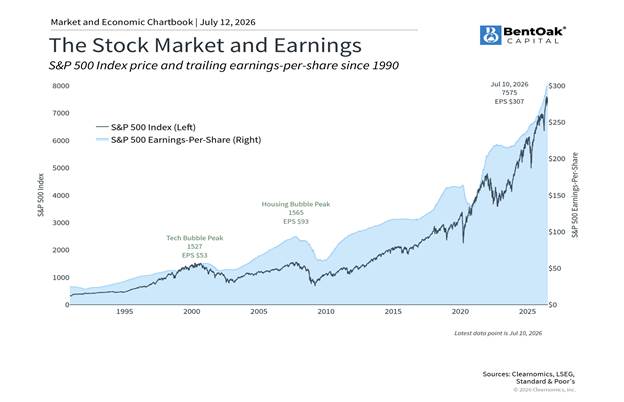
When markets move higher, it is natural to ask whether prices have moved too far, too fast. That question is worth asking. Pullbacks are a normal part of market cycles and can serve as a healthy reset when portions of the market become stretched.
At the same time, markets are not driven by sentiment alone. Over time, earnings, cash flow, margins, capital investment, and productivity all matter. This is why we continue to focus on the fundamentals beneath the headlines.
AI Investment Is Bigger Than Technology Alone
Artificial intelligence remains one of the most discussed investment themes of 2026. Much of the attention has focused on software, chips, and the companies leading AI development. But the economic impact is broader than the technology sector alone.
Major technology companies are investing heavily in AI-related infrastructure, including data centers, electrical systems, cooling systems, fiber networks, chips, concrete, steel, and copper. In other words, AI capital spending is not just a software story, it is one that runs across industries.
HYPERSCALER CAPITAL EXPENDITURES CONTINUE TO RISE
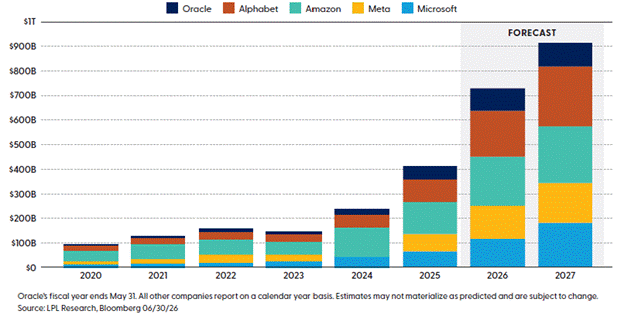
That investment can support economic activity in the near term. Over the longer term, AI may also contribute to productivity growth, but it’s build out and implementation is one that may take several years to see broad effects.
The reason is practical: AI is only as useful as the data and systems it can access. Many businesses still rely on older systems that are difficult to integrate with modern AI tools. Adoption may be rapid in some areas and slower in others. The productivity benefits may therefore arrive unevenly across industries.
For investors, the key takeaway is balance. AI may be an important long-term driver of productivity and corporate investment, but we are likely still in the early innings. Excitement around a technology theme does not remove the need for diversification, valuation discipline, and patience.
Inflation Remains Sticky
Inflation has cooled from its post-pandemic peak, but it remains an important issue for households, businesses, and policymakers. Importantly, inflation does not affect everyone in the same way.
Headline inflation measures provide broad readings across a basket of goods and services. But each household experiences inflation based on what it actually buys. Energy, travel, food, housing, healthcare, insurance, education, and various goods and services can all move at different rates.
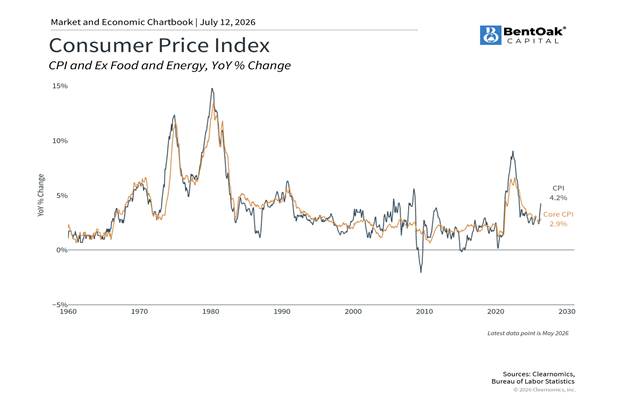
For retirees and those approaching retirement, inflation is especially important because it affects purchasing power over time. Even modest differences in annual inflation assumptions can materially impact a long-term financial plan.
That is why inflation should not be treated as a one-time headline. It should be incorporated into cash flow planning, portfolio construction, withdrawal strategies, and stress testing.
Energy Prices Still Matter Across the Economy
Energy remains one of the most important variables in the inflation outlook. Oil and natural gas prices influence far more than the cost of filling up a vehicle. They can affect transportation, shipping, fertilizer, food production, air travel, manufacturing, and utility costs to name a few.
Supply Forecasts Remain Supportive of Oil
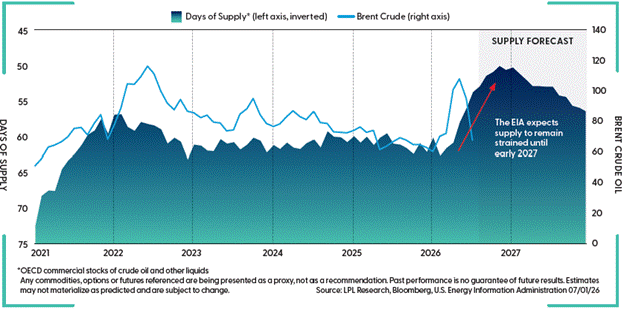
Geopolitical developments and shipping disruptions can place pressure on supply and contribute to price volatility. At the same time, rising energy demand from data centers and AI infrastructure may add a new layer of demand over the coming years.
For Texas and other energy-producing regions, higher energy prices can have a dual effect. They may increase costs for consumers and businesses, but they can also support profitability and employment in parts of the energy sector.
This is another reminder that economic data is rarely one-dimensional. The same development can create both challenges and opportunities depending on the household, business, or region involved.
Interest Rates May Stay Higher Closer to Historical Averages
After many years of very low interest rates, today’s fixed income environment looks different. Yields across many areas of the bond market are more attractive than they were for much of the post-2008 period.
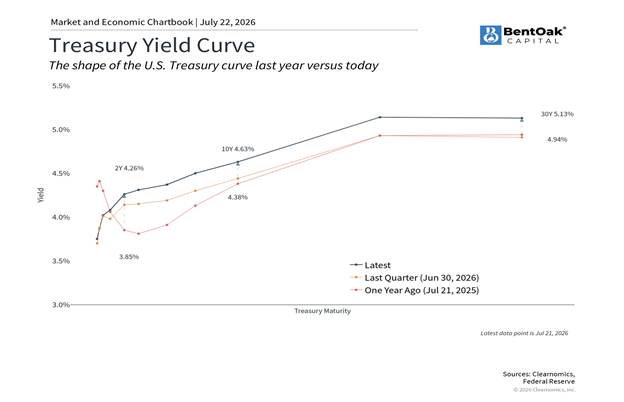
That has created potential benefits for investors seeking income and portfolio ballast. Bonds can play a meaningful role in diversified portfolios, particularly when investors do not need to reach as far on the credit spectrum to generate yield or incorporate tax-exempt income from municipal bonds.
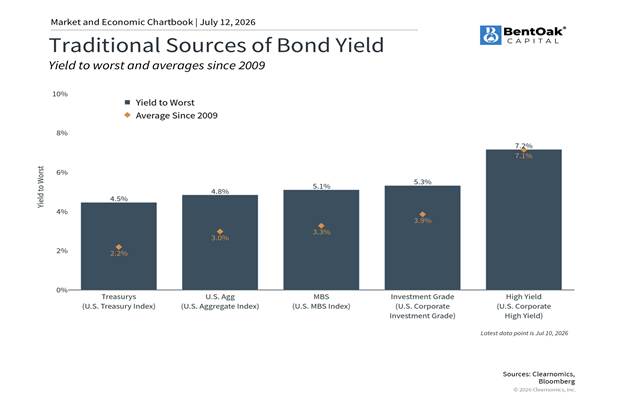
However, fixed income still involves risk. Bond prices can decline when interest rates rise, and investors should consider duration risk, credit risk, liquidity risk, call risk, and reinvestment risk. The appropriate fixed income allocation depends on each investor’s time horizon, income needs, tax situation, and overall financial plan.
The rate environment remains complicated. Inflation, Federal Reserve policy, Treasury issuance, national debt levels, and global central bank decisions can all influence yields. The relationship between Fed rate changes and consumer borrowing rates, such as mortgage rates, is not always direct or immediate.
The Federal Reserve’s Path Is Still Uncertain
The Federal Reserve remains a central part of the market conversation. Expectations for rate cuts, rate hikes, or an extended pause can shift quickly as inflation, employment, growth, and financial conditions evolve.
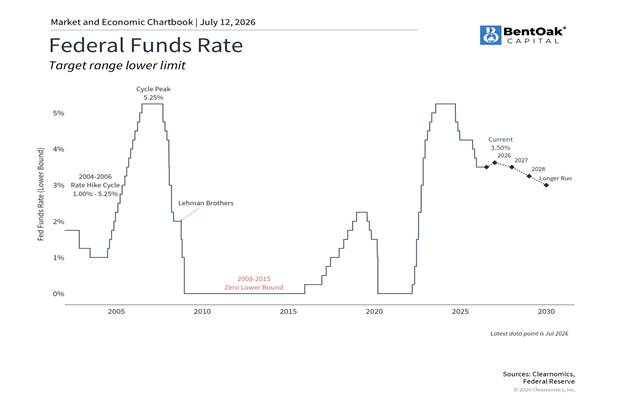
At the same time, communication from policymakers can influence investor expectations. Markets often react not only to what the Federal Reserve does, but also to how it describes the path ahead.
In our opinion, based on current conditions, a gradual policy path appears more likely than a dramatic shift, though outcomes may differ materially. Investors should avoid building a financial plan around a single interest rate forecast.
Midterm Elections May Bring Volatility, but History Offers Perspective
Midterm election years often bring increased political headlines and market uncertainty. The market wants to know which party will control the House and Senate, whether gridlock will increase, and which sectors may be affected by policy changes.
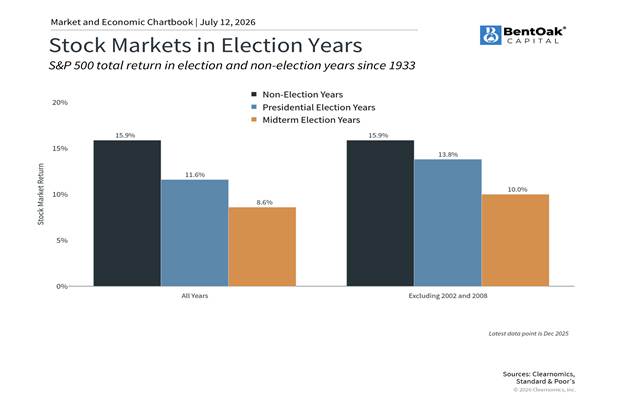
Policy can influence taxes, regulation, healthcare, energy, banking, and other sectors. But markets are ultimately driven by a broader set of factors, including earnings, interest rates, inflation, productivity, and investor expectations.
Political uncertainty can create volatility, but it should not automatically override a disciplined long-term investment process.
IPOs Are a Sign of Market Activity, Not Automatically an Investment Opportunity
The renewed conversation around high-profile initial public offerings is another sign of changing market conditions. IPO activity can indicate that companies see a favorable environment to raise capital and provide liquidity to early investors.
That is generally healthy for capital markets.
However, IPO performance and IPO economics are not the same thing. IPOs are often priced in a way that benefits sellers, and performance for newly public companies can vary widely. For many long-term investors, exposure to newly public companies may occur naturally over time through diversified funds, indexes, or professionally managed strategies rather than through buying immediately at the offering.
The broader point is that access alone is not a financial plan. A disciplined investment process should evaluate how any security or asset class fits within the investor’s goals, risk tolerance, time horizon, and existing portfolio.
What Should Actually Change a Financial Plan?
The economy, markets, inflation, interest rates, elections, and technology all matter. We monitor them closely because they influence portfolios and planning assumptions.
But most of these macro developments should not radically change a well-built financial plan.
What should prompt a planning conversation are changes in a client’s life, goals, or circumstances, such as:
- A retirement date moving earlier or later
- A change in health or family needs
- A major purchase or sale
- A child’s or grandchild’s education goal
- A shift in income, spending, or charitable intent
- An event that warrants a change in risk tolerance
- A new estate, tax, or legacy planning priority
Headlines will always be part of investing. The purpose of planning is to keep headlines from becoming the driver of decisions.
The Bottom Line
The first half of 2026 has reinforced a familiar lesson, and uncertainty is normal. The U.S. economy has remained resilient, AI investment has created both excitement and complexity, inflation is still relevant, and interest rates may remain higher than investors became accustomed to in the last decade.
None of this means investors should ignore risk. It means risk should be addressed through planning, diversification, and disciplined decision-making.
A strong financial plan is not built around predicting every headline. It is built around helping clients move toward their goals through a world that is always changing.
IMPORTANT DISCLOSURE INFORMATION: Past performance may not be indicative of future results. Different types of investments involve varying degrees of risk. Therefore, it should not be assumed that future performance of any specific investment or investment strategy (including the investments and/or investment strategies recommended and/or undertaken by BentOak Capital [“BentOak”]), or any non-investment related services, will be profitable, equal any historical performance level(s), be suitable for your portfolio or individual situation, or prove successful. BentOak is neither a law firm, nor a certified public accounting firm, and no portion of its services should be construed as legal or accounting advice. Moreover, you should not assume that any discussion or information contained in this document serves as the receipt of, or as a substitute for personalized investment advice from BentOak. Please remember that it remains your responsibility to advise BentOak, in writing, if there are any changes in your personal/financial situation or investment objectives for the purpose of reviewing/evaluating/revising our previous recommendations and/or services, or if you would like to impose, add, or to modify any reasonable restrictions to our investment advisory services. A copy of our current written disclosure Brochure discussing our advisory services and fees is available upon request at www.bentoakcapital.com/disclosure. The scope of the services to be provided depends upon the needs of the client and the terms of the engagement. Historical performance results for investment indices, benchmarks, and/or categories have been provided for general informational/comparison purposes only, and generally do not reflect the deduction of transaction and/or custodial charges, the deduction of an investment management fee, nor the impact of taxes, the incurrence of which would have the effect of decreasing historical performance results. It should not be assumed that your account holdings correspond directly to any comparative indices or categories. Please Also Note: (1) performance results do not reflect the impact of taxes; (2) comparative benchmarks/indices may be more or less volatile than your accounts; and, (3) a description of each comparative benchmark/index is available upon request. Please Note: Limitations: Neither rankings and/or recognitions by unaffiliated rating services, publications, media, or other organizations, nor the achievement of any designation, certification, or license should be construed by a client or prospective client as a guarantee that he/she will experience a certain level of results if BentOak is engaged, or continues to be engaged, to provide investment advisory services. Rankings published by magazines, and others, generally base their selections exclusively on information prepared and/or submitted by the recognized adviser. Rankings are generally limited to participating advisers (see link as to participation criteria/methodology, to the extent applicable). Unless expressly indicated to the contrary, BentOak did not pay a fee to be included on any such ranking. No ranking or recognition should be construed as a current or past endorsement of BentOak by any of its clients. ANY QUESTIONS: BentOak’s Chief Compliance Officer remains available to address any questions regarding rankings and/or recognitions, including the criteria used for any reflected ranking.