
In 1960, Chubby Checker turned a dance move called “The Twist” into a national craze. If you’ve heard the song once, you can almost hear it now with the energetic rhythm. A little over a year later, the Kennedy Treasury and the Federal Reserve borrowed the name for something far less fun: a plan to hold down long-term borrowing costs without touching short-term rates. Wall Street spent this week dusting off that old playbook, and the nickname came with it. And now you are starting to put together why many are referencing an almost 65 year old song, and recent monetary policy actions out of DC (same questions I had back in 2011).
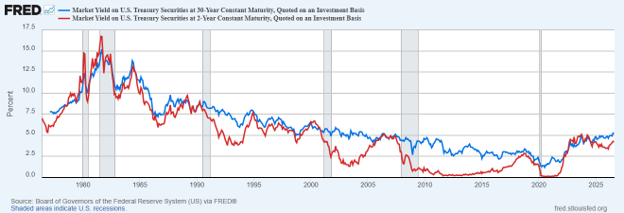
On August 19, Treasury Secretary Scott Bessent announced that Treasury would at least double the size of its buybacks of longer-dated government debt, raising the cap on individual operations from $2 billion to a minimum of $4 billion and adding more operations per quarter starting in early September. The move followed a rough stretch for long bonds. The 30-year yield had climbed above 5.3%, its highest level in nearly two decades, and the 10-year had pushed to the 4.75%. None of that happened for one reason. Sticky inflation, a flood of AI-related corporate debt competing for the same buyers, growing unease about the size of the federal deficit, and questions about the Fed’s recent actions under its new chairman, Kevin Warsh, all played a part.
What Treasury Actually Proposed
The mechanics are less dramatic than the headline. Treasury isn’t printing money or setting monetary policy; it’s simply buying back more of its own outstanding long bonds in the open market, funded by issuing more short-term bills. Barclays estimated the initial expansion adds roughly $64 billion a year in purchases. The Wall Street Journal put the ceiling closer to $128 billion if Bessent follows through on later comments that the buyback could grow larger still. Either figure is a rounding error against $40 trillion in outstanding debt. The dollar amount was never really the point. The signal was that Treasury will lean against the bond market when yields move sharply against it.
The 30-year fell some on the announcement, the 10-year eased a few basis points, and stocks rallied. By Thursday, both had largely round-tripped back toward where they started, a reminder that a few billion dollars of buying doesn’t overwhelm a multitrillion-dollar market for long. Bessent told CNBC the same day that current yields don’t reflect economic fundamentals and that he has “a big toolkit” left to use.
Not the First Twist, and Not Quite the Same One
The original Operation Twist, in 1961, had the Fed sell short-term Treasuries and buy longer-dated ones, aiming to lower long-term rates while keeping short rates high enough to protect the dollar’s gold peg. It worked, but only modestly with economists later estimating that it moved long-term yields by about 15 basis points. The 2011 sequel, was much larger: $400 billion swapped from short into long maturities over nine months, aimed at reviving an economy still limping out of the Great Recession.
“Monetary policy is not Thor’s hammer,” Richard Fisher, then president of the Dallas Fed, told a Dallas audience that September.
Fisher dissented from that 2011 decision, arguing that the benefits looked too thin next to the risks to the Fed’s balance sheet and independence. His skepticism is worth remembering now, because this round has an even smaller footprint relative to the market it’s trying to move.
This version differs from both predecessors in one important way. Treasury is doing the “twisting”, not the Fed, and the economy isn’t slack. Inflation, not unemployment, is the concern driving policy debates. Economists at Evercore have called it a “small-scale” echo of the original rather than a genuine repeat. This is another instance where we can use the Mark Twain quote, “history doesn’t repeat itself, but if often rhymes.”
Are Rates Actually High, or Just Normal Again?
Here’s the context that gets lost in the headlines.
A 4.7% ten-year yield looks alarming next to 2015 for most anyone younger than a Baby Boomer. It looks almost “ordinary” when zooming out and seeing a long-term average yield of ~5.80% over the past 6 plus decades.
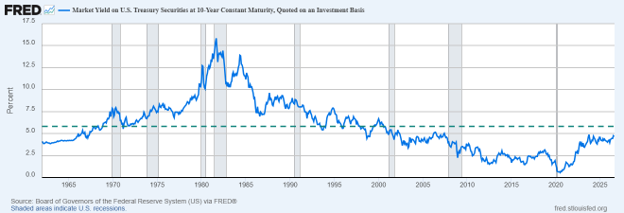
Years of near-zero Fed policy and quantitative easing after the 2008 crisis pinned yields well below where they’d otherwise have settled, for the better part of a decade. That stretch was the anomaly, not the exception. Measured against a longer sweep of history, today’s yields sit closer to a normal range, even if the climb has been relatively fast over the past 5 years and the level is uncomfortable for anyone financing a mortgage, a car, or a business expansion right now.
Where That Leaves Things
Operation Twist, in any of its three incarnations, has never been a cure but rather a tool. What happens to yields from here will depend far more on inflation data, the deficit’s trajectory, and the Fed’s actions under its new chairman than on how many bonds Treasury repurchases each quarter. As noted above, higher yields result in increased borrowing costs for companies, homebuyers and government which can result in cooling growth and possibly reduced spending. But for investors, retirees, and those allocating to fixed income for diversification benefits, this shift is a positive. Many bonds are offering higher income than they did a few years ago and when structured properly, may provide the conservative portion of a portfolio with the potential for higher income.
Sources
1. Treasury Bond Buybacks Evoke Memory of Fed’s ‘Operation Twist’ — Bloomberg via Yahoo Finance
2. Bessent says Treasury buyback operation could be more than $4 billion — CNBC
3. Treasury yields rebound, wiping out the decline following Bessent’s intervention — CNBC
4. Bond yields fall after Treasury announces surprise move to ease rising rates — NBC News
5. Explaining Dissent on the FOMC Vote for Operation Twist — Richard W. Fisher, Federal Reserve Bank of Dallas, Sept. 27, 2011
7. Bessent’s $4 billion bond plan is like ‘rearranging deckchairs on the Titanic’ — Fortune
IMPORTANT DISCLOSURE INFORMATION: Past performance may not be indicative of future results. Different types of investments involve varying degrees of risk. Therefore, it should not be assumed that future performance of any specific investment or investment strategy (including the investments and/or investment strategies recommended and/or undertaken by BentOak Capital [“BentOak”]), or any non-investment related services, will be profitable, equal any historical performance level(s), be suitable for your portfolio or individual situation, or prove successful. BentOak is neither a law firm, nor a certified public accounting firm, and no portion of its services should be construed as legal or accounting advice. Moreover, you should not assume that any discussion or information contained in this document serves as the receipt of, or as a substitute for personalized investment advice from BentOak. Please remember that it remains your responsibility to advise BentOak, in writing, if there are any changes in your personal/financial situation or investment objectives for the purpose of reviewing/evaluating/revising our previous recommendations and/or services, or if you would like to impose, add, or to modify any reasonable restrictions to our investment advisory services. A copy of our current written disclosure Brochure discussing our advisory services and fees is available upon request at www.bentoakcapital.com/disclosure. The scope of the services to be provided depends upon the needs of the client and the terms of the engagement. Historical performance results for investment indices, benchmarks, and/or categories have been provided for general informational/comparison purposes only, and generally do not reflect the deduction of transaction and/or custodial charges, the deduction of an investment management fee, nor the impact of taxes, the incurrence of which would have the effect of decreasing historical performance results. It should not be assumed that your account holdings correspond directly to any comparative indices or categories. Please Also Note: (1) performance results do not reflect the impact of taxes; (2) comparative benchmarks/indices may be more or less volatile than your accounts; and, (3) a description of each comparative benchmark/index is available upon request. Please Note: Limitations: Neither rankings and/or recognitions by unaffiliated rating services, publications, media, or other organizations, nor the achievement of any designation, certification, or license should be construed by a client or prospective client as a guarantee that he/she will experience a certain level of results if BentOak is engaged, or continues to be engaged, to provide investment advisory services. Rankings published by magazines, and others, generally base their selections exclusively on information prepared and/or submitted by the recognized adviser. Rankings are generally limited to participating advisers (see link as to participation criteria/methodology, to the extent applicable). Unless expressly indicated to the contrary, BentOak did not pay a fee to be included on any such ranking. No ranking or recognition should be construed as a current or past endorsement of BentOak by any of its clients. ANY QUESTIONS: BentOak’s Chief Compliance Officer remains available to address any questions regarding rankings and/or recognitions, including the criteria used for any reflected ranking.